Lizzie Borden |
|||||
| |
|||||
| Yesterday in Old Fall River: A Lizzie Borden Companion -- Paul Dennis Hoffman's examination of a crime and its aftermath. This historical encyclopedia attempts to make sense of the people who were part of the Lizzie Borden mystery. For the first time, all of those involved with the case, over 650 in all, in any way have a listing that includes a biography.
Lizzie Borden Elizabeth Engstrom
The Borden murders took place in Fall River, Massachusetts, the house where it happened is now a popular Bed & Breakfast. David Rehak spent eight years of study, research and years of writing this book. He became intrigued with Lizzie Borden after viewing her A&E biography on in 1996. Lizzie was an average, unremarkable woman, a nobody. Did Lizzie Borden take an "axe" and kill her parents? This new edition is revised, abridged and streamlined with interesting and relevant information, including over 20 new photos. 70 photographs and illustrations |
Lizzie Borden born July 19, 1860, Fall River, Mass., was charged with murdering her stepmother and father; her trial became a national sensation in the United States.
Lizzie's mother died in 1862 leaving two daughters. Her father, Andrew Borden, an affluent, strict, tight businessman only interested in money. He was worth $500,000 in gold but refused to install plumbing in his home. Andrew married spinster Abby Durfee Gray, 38, in 1865, when Lizzie was three and Emma was 12. Abby rarely left home except to visit a half-sister. Lizzie never dated; she was well liked and active in civic and charitable work. She taught Sunday school at Central Congregational, was an officer of the Christian Endeavor Society, and member of the Women's Christian Temperance Union. Emma 42, rarely left home except to visit a nearby spinster, Alice Russell. Both daughters were upset about their father withdrawing their inheritance for Abby. Lizzie and Emma were frequently obsessed with disagreement over their father's financial decisions. Five years before the murders, after Andrew put a rental house in Abby's name, Lizzie and Emma were so enraged that he bought each of them a house of equal value. Emma and Lizzie quit eating with their parents. They referred to Abby as "Mrs. Borden." Bridget Sullivan, 26, a recent Irish immigrant, was in the Borden's' service for nearly three years. She testified that the Borden's never raised their voices to each another. Andrew and Abby knew Lizzie stole their cash and her jewelry when they ordered a police investigation. Abby bolted her door to Lizzie's room. Andrew' put a strong lock on the master bedroom, but left the key on a sitting-room mantel. Neither Lizzie nor Emma spoke to Uncle John because he planned to reduce their inheritance. Abby would place the farm in her name and make John's brother-in-law, John Morse, the caretaker. A week before the murders, Emma went to Fairhaven to escape the heat while Lizzie shared a beach house with five friends at Buzzards Bay. Her friends noticed that she seemed unhappy and distant. She left Buzzards Bay early to return home. On August 3, the day preceding the murders, Lizzie tried to obtain illegal prussic acid. The pharmacist's testimony was excluded in her trial,. The same day Lizzie had lunch with Abby and Andrew for the first time in five years. That evening she visited Alice Russell about her father's enemies before going home and straight to her room, since Uncle John was spending the night. Thursday morning, August 4, 1892, Bridget and Andrew were the first ones up. Breakfast was mutton soup, sliced mutton, pancakes, bananas, pears, cookies, and coffee. Uncle John and Mr. Borden left home to carry out separate business. Bridget went to the back yard to vomit. Without compassion, Abby ordered her to wash all the windows inside and out immediately. Abby was preparing to go to the bank to sign the deed for ownership of the farm. She did not want Bridget inside hearing her argue with Lizzie. Abby was blitzed while making Uncle John's bed in the guest room, at about 9:00 A.M. Andrew was murdered 2 hours later. They died within 1-2 hours of each other. Lizzie ironed handkerchiefs, sewed, visited with Bridget and read. Andrew napped on the sofa after returning home at 10:30. Bridget was resting in her room. At 11:15 A. M. Bridget heard Lizzie scream that her father had been murdered. Lizzie sent Bridget for Alice Russell and Dr. Bowen. A neighbor, Adelaide Churchill, responded to Lizzie's cries and asked about her Abby. Lizzie told her she felt that Abby had been killed too. When Bridget returned with Miss Russell and Dr. Bowen, Andrew pronounced dead. After a brief search, Bridget and Mrs. Churchill found Abby's body upstairs. Dr. Bowen sent a telegram to Emma in Fairhaven. In no apparent hurry, she did not return home until evening. Lizzie claimed she was in the barn before she returned to find her father dead. Witnesses who saw Lizzie after the murders testified there was no blood on her. She was menstruating at the time of the murder. Bridget, who adored Lizzie for her kindness, was the only other person in the house during the murders. When Uncle John returned for lunch he became the first suspect. A detective noticed a foot-long stick in the flames. In the basement.he found a hatchet head, washed and rolled in furnace ash. Lizzie had motive, opportunity and awareness of culpability. Her conflicting responses at an inquest were not allowed into evidence. Lizzie was arrested and tried for both murders in June 1893, but was acquitted due to a lack of substantive evidence. Most people refused to believe that a wealthy Sunday Schoolteacher would kill her parents. Major newspapers, feminists groups and clergy criticized her arrest. During the entire ordeal she appeared confident and composed. Lizzie's attorney, George D. Robinson, was a former Massachusetts Governor. After being sequestered for 15-days, the jury took one hour to find her not guilty. Henry Trickey, a Boston Globe reporter, paid private detective, Edwin McHenry, $500 for affidavits they published before they were found to be bogus. Trickey was indicted for obstruction of justice and The Globe apologized. Lizzie inherited half of her father's estate and bought a mansion for herself and Emma in Fall River's finest neighborhood. She was no longer accepted by the citizens of Fall River and no longer welcome at Central Congregational Church.She led a reclusive life. In 1904 she was caught shoplifting. In 1913, Emma abruptly moved and never spoke to Lizzie again. Lizzie who loved the theatre was a fan of actress Nance O'Neill. They developed a close friendship after meeting at a hotel. Lizzie lived alone in her mansion until she died of pneumonia, a spinster in 1927. In New Hampshire, Emma read of her death in the news, but did not respond. Ten days later, Emma died from a fall. Both left their assets to the Animal Rescue League. Sources Lizzie Border — Wasp -- The ax murders of Andrew and Abby Borden provide a perfect case study of Anglo-Saxon America. The Lizzie Borden / Fall River Case Study -- Using primary source materials from the Lizzie Borden ax murder trial and from Fall River, Massachusetts, this project teaches to reconstruct the historical past using evidence at hand. The virtual archive and tools developed for this project include materials not generally available anywhere else. Center for Computer-Based Instructional Technology at the University of Massachusetts at Amherst Ghost Investigator Volume 2: From Gettysburg, PA to Lizzie Borden, AX -- Ghost Investigator Linda Zimmermann examines hauntings in New York, Pennsylvania and Massachusetts. Cases include a private home, an abandoned penitentiary in Philadelphia, the battlefields of Gettysburg, and the scene of America's most famous ax murder--Lizzie Borden's house. Find A Grave - Lizzie's final resting place and online memorial Berni, Christine. Taking an axe to history: the historical Lizzie Borden and the postmodern historiography of Angela Carter. CLIO . Fall 1997 v27 n1 p29 (27). Indiana University, Purdue University of Fort Wayne. 1997 King, Florence. A WASP looks at Lizzie Borden. National Review, Inc . 1992 Kari & Associates 12/13/11 Copyright Kari Sable 1994-2006 |
 
History's Mysteries - The Strange Case of Lizzie Borden (History Channel 2005) -- Who was Lizzie Borden? Did she really murder her father and stepmother on that muggy morning in August 1892? Or does she stand wrongly accused? Case Reopened: Lizzie Borden with Ed McBain VHS -- Lizzie Borden took an axe, and gave her mother 40 whacks. When she saw what she had done, she gave her father 41. Or so goes the nursery rhyme. But a hundred years later how many people know the real story of Lizzie Borden? Lizzie was tried, but never convicted of the hatchet murders of Abby and Andrew Borden. Case Reopened fuses history, mystery and scientific research by to re-examine some of our most notorious unsolved crimes. Though she proclaimed her innocence until her dying day, she was associated with murder. Lizzie, a respectable spinster, was tried for the crime. Though she was acquitted, she lived the rest of her life a pariah. BIOGRAPHY examines the evidence in search of the truth, including period accounts, police reports and crime-scene photos. Discover how the crime and trial were sensationalized worldwide and meet Borden experts with insight into Lizzie's life.
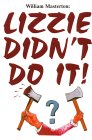
Lizzie Didn't Do It! The Borden Tragedy: A Memoir of the Infamous Double Murder at Fall River, Mass., 1892 |